A warehouse robot earns its place when it moves goods safely through a live site, not when it completes a polished demo. The next useful gains will come from better picking, longer operation, and fewer stops when the floor changes.
- Picking mixed items without fixed layouts
- Working beside people without blocking them
- Showing clear costs for each task
Picking from messy shelves
Most warehouse work involves objects that differ in size, shape, weight, and packaging. Handling one known box solves a narrow task; handling mixed stock from changing shelves gives the robot a wider job.
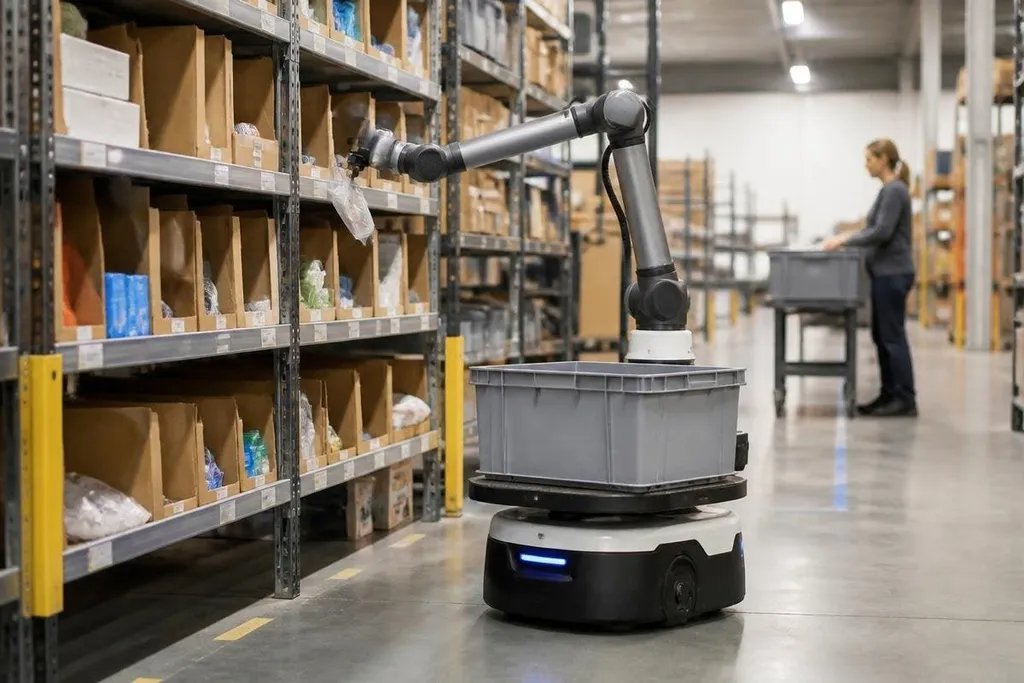
The parts to watch are the camera system, gripper, and control software working together. The camera finds an object, the software chooses a grip, and the arm checks its position while lifting. A small error can crush a soft package or drop a glass item.
The useful proof will be simple: a long, uncut run with many item types, clear success rates, and no hidden human reset between attempts.
Buyers also need to know how the robot behaves when it cannot identify an item. A safe pause is better than a bad guess.
Robots that fit the whole workflow
A picking arm can work well and still leave a worker waiting at the next step. The larger gain comes when mobile robots, conveyors, storage systems, and picking arms pass work between each other without manual handoffs.
That requires shared maps, clear task rules, and reliable signals between machines. A mobile robot may use LiDAR to measure its surroundings, while a fleet system assigns routes and tasks. If those systems disagree, the robot stops or takes the wrong route.
Watch for deployments that report the full task time, not only the arm's speed. One that lifts a package in 4 seconds may save little if workers wait 30 seconds for the next tote.
A warehouse robot's safety record starts with the load, route, speed, and point where a person steps in. Robot24.com can connect those details to named trials and test dates before the next section looks at robots sharing floor space with people.
Safer work beside people
Shared work areas need more than a stop button. The robot must detect people, slow down near them, and stop when its sensors cannot confirm a safe path. Its speed, arm reach, load, and stopping distance all affect the layout around it.
The details worth checking include sensor coverage, restart behavior, and the position of the emergency stop. Even a robot can meet a paper rule and still force workers to walk around it all day if its work zone is poorly placed.
The strongest systems will make their limits easy to see. A clear warning, a recorded stop, and a simple restart procedure help a supervisor decide whether the machine belongs on a busy shift.
The cost test
The robot's purchase price tells only part of the story. A site also pays for grippers, software, installation, floor changes, service, training, and time lost during faults.
The useful number is cost per completed task. That figure should include the robot's working hours, human support, failed picks, charging time, and maintenance. A low hardware price can look different after these costs are added.
Some makers may avoid publishing a full figure while systems are still being tested. That leaves a buyer with a basic question: which costs are known, and which ones depend on the site?
I'd skip any purchase decision based on a demo alone. A short trial with the site's own shelves, packages, traffic, and shift rules tells you more than a clean video.
A buyer's check before a pilot
Use this list before asking for a site trial:
- Ask for the task success rate across your own item mix.
- Record how often a person must reset or guide the robot.
- Measure the full cycle from item request to completed handoff.
- Check what happens when sensors lose sight of a person or package.
- Price service, spare parts, software, training, and floor changes.
- Set a stop rule for safety, uptime, and cost per task.
The next warehouse robot worth watching will show its work under ordinary site conditions. Until a system reports those results, call it a promising test, not a finished answer.